# The 2026 DORA Mandate: Architecting Next.js and Cloud Infrastructure for European Digital Operational Resilience
Look, the EU's Digital Operational Resilience Act (DORA) just completely nuked how we handle financial infra. We're hitting the strict enforcement phase in 2026. This isn't some theoretical exercise anymore. It's a massive, auditable engineering headache with fines that will literally bankrupt your company if you screw up.
You've got DevSecOps teams trying to ship modern apps with Next.js and distributed cloud garbage. DORA drops a massive compliance matrix right on your head. ENISA tries to give us the technical scaffolding. But translating those high-level government PDFs into actual working code that won't blow up in production is an absolute pain in the ass when you're trying to meet deadlines.
We're going to tear down DORA requirements using ENISA standards. We'll map them straight to Next.js App Router setups, edge computing, and cloud-native deployments. Expect to see architectural bottlenecks, supply chain disasters, incident telemetry footguns, and the brutal financial reality of ignoring this stuff. Bottom line: we'll look at how platforms like Bryxe automate this nightmare, letting you actually write code instead of arguing with auditors.
1. Deciphering DORA and ENISA for DevSecOps Engineering
Let's be real. DORA kills the old way of doing cybersecurity. Forget just blocking hackers. We are talking operational resilience. You need a system that can take a punch, bleed a little, and keep running when your cloud provider inevitably has a janky region outage.
ENISA translates DORA into technical specs. For us engineers, this means static vulnerability scans are dead. You need continuous, automated proof that your system isn't garbage.
Here's the DORA breakdown for DevSecOps: - ICT Risk Management (Articles 5-16): You need a framework to catch, fix, and recover from risks. Period. - ICT-Related Incident Reporting (Articles 17-23): If something breaks, you have a tight window to report it with deep technical telemetry. No guessing allowed. - Digital Operational Resilience Testing (Articles 24-27): Stop assuming your code works. Continuous threat-led penetration testing (TLPT) and chaos engineering are mandatory. - ICT Third-Party Risk Management (Articles 28-44): Lock down your software supply chain. Third-party dependencies are the easiest way to get owned.
2. Next.js App Router: Architectural Implications for Resilience
Next.js 14 and the App Router are fast. Server Actions, React Server Components (RSC), edge runtimes. Great for users. But under the hood, they blow up your attack surface and completely change how we handle DORA.
React Server Components (RSC) Data Leaks
RSCs run on the server. They serialize data and fire it to the client. Here's the gotcha: if you don't isolate your logic, you will accidentally leak raw database rows or internal environment variables right into the browser payload, violating ENISA's Data Protection (Control Family DP) rules in the dumbest way possible.
Mitigation in Next.js:
Use the server-only package. It structurally enforces ENISA's data separation so nobody accidentally imports secure functions into client components and ruins your week.
import 'server-only';
import { db } from '@/lib/db';
import { decryptData } from '@/lib/crypto';

// This function will throw a build error if imported in a Client Component
export async function getSecureFinancialData(userId: string) {
  const data = await db.query('SELECT * FROM transactions WHERE user_id = $1', [userId]);
  return decryptData(data);
}
Edge Computing vs. Node.js Runtimes
Pushing Next.js middleware to the edge makes it fast. It also creates a massive compliance footgun. ENISA demands you know exactly where your data lives. If your edge functions process PII in random unapproved regions because Vercel routed it weirdly, you just violated DORA. Nuke the global edge setting if you can't guarantee EU sovereignty.
3. Mapping ENISA Standards to Next.js Infrastructure
Here's the harsh truth. You have to map ENISA controls to your actual infrastructure. Look at the table below for a standard Next.js setup on AWS or Vercel.
| DORA Pillar | ENISA Control Family | Next.js / Cloud Architecture Implementation |
|---|---|---|
| ICT Risk Management | Asset Management (AM) | Automated CI/CD SBOM generation; tracking Next.js dependencies (npm) via tooling. |
| ICT Risk Management | Access Control (AC) | Implementing OAuth 2.0 / OIDC in NextAuth.js with mandatory MFA and RBAC for all Server Actions. |
| Incident Reporting | Logging and Monitoring (LM) | Integrating OpenTelemetry natively in Next.js instrumentation.ts for distributed tracing across RSCs and Edge functions. |
| Resilience Testing | Continuous Testing (CT) | Automated integration tests in Vercel/GitHub Actions; Chaos testing API endpoints mimicking high-latency databases. |
| Third-Party Risk | Supply Chain Security (SC) | Pinning exact package versions in package.json, running npm audit in CI, using Subresource Integrity (SRI) for external scripts in next.config.js. |
4. Incident Reporting and Cloud Telemetry
Article 19 of DORA demands initial reports for major incidents within ridiculous timeframes, like 4 hours. You can't just grep your logs manually anymore. It's mathematically impossible.
ENISA wants automated telemetry pipelines. For Next.js, that means instrumenting the framework to spit out high-fidelity tracing before things go sideways.
Implementing OpenTelemetry in Next.js for ENISA Compliance
Next.js has this experimental instrumentation.ts file. Use it to bootstrap OpenTelemetry.
// instrumentation.ts
import { registerOTel } from '@vercel/otel';

export function register() {
  registerOTel({
    serviceName: 'bryxe-financial-dashboard',
    // Ensure telemetry data is routed to an EU-based, DORA-compliant SIEM
    traceExporter: new MyCustomDORATraceExporter({
      endpoint: process.env.SIEM_ENDPOINT,
    }),
  });
}
I'm tired of seeing this in PRs. Be extremely careful. Don't let your logs capture sensitive user data. You'll satisfy DORA but get completely wrecked by GDPR. It's a classic engineering catch-22.
5. Resilience Testing: Chaos Engineering in the App Router
DORA says test for resilience, not just security. What happens when your downstream services inevitably crap out?
In Next.js, this is all about error.tsx and loading.tsx boundaries. If your primary Postgres cluster goes offline, does your whole app crash? Or does it gracefully serve stale cache data?
Architectural Requirement: Make sure your fetch calls are wrapped tight with error boundaries and caching.
// app/dashboard/page.tsx
import { Suspense } from 'react';
import { FinancialSummary } from './FinancialSummary';
import { Skeleton } from '@/components/Skeleton';
import { ErrorBoundary } from 'react-error-boundary';

export default function Dashboard() {
  return (
    <ErrorBoundary fallback={<div className="p-4 bg-red-100">Service temporarily degraded.</div>}>
      <Suspense fallback={<Skeleton className="h-64 w-full" />}>
        <FinancialSummary />
      </Suspense>
    </ErrorBoundary>
  );
}
Isolate your components. If the FinancialSummary microservice dies, it shouldn't take down the entire trading interface. That's the kind of operational resilience auditors want to see before they sign off.
6. Third-Party Risk Management: The NPM Supply Chain
I'm tired of seeing this in PRs. Article 28 targets third-party risk. In the Node ecosystem, this is a total nightmare. Your average Next.js app pulls in thousands of transitive dependencies written by god knows who. Remember that Polyfill.io supply chain attack? That's exactly the kind of mess DORA is trying to stop.
Engineering Mandates: 1. Software Bill of Materials (SBOM): Generate and maintain a fresh SBOM every single time you ship to prod. 2. Subresource Integrity (SRI): Loading external scripts? Enforce SRI or don't do it at all.
In next.config.js:
/** @type {import('next').NextConfig} */
const nextConfig = {
  experimental: {
    sri: {
      algorithm: 'sha384',
    },
  },
  // Ensure strict CSP to prevent malicious third-party script execution
  async headers() {
    return [
      {
        source: '/(.*)',
        headers: [
          {
            key: 'Content-Security-Policy',
            value: "default-src 'self'; script-src 'self' 'strict-dynamic'; connect-src 'self' https://api.bryxe.com;"
          }
        ]
      }
    ]
  }
};
module.exports = nextConfig;
7. The Financial Impact of DORA Non-Compliance
DORA isn't a suggestion. The fines are insane. They can hit you for up to 1% of your average daily worldwide turnover.
ROI Calculation for DevSecOps Automation
Let’s model a mid-sized FinTech firm with €500M annual turnover. - Potential Daily Fine: Up to €13,698 per day of non-compliance. - Manual Compliance Cost: A team of 4 compliance engineers at €120,000/year = €480,000/year. - Downtime Cost: Average cost of IT downtime is €8,000 per minute. A 4-hour outage costs €1.92M.
Let's be real. Spending money on automated DORA tools and resilient Next.js architecture pays for itself immediately. It's basic math compared to the risk of doing it manually.
8. Automating DORA Compliance with Bryxe
Manually tracking ENISA standards across a sprawling Next.js app is a fool's errand. Bryxe hooks directly into your DevSecOps pipeline to handle this automatically.
How Bryxe Solves DORA for Next.js:
- Continuous SBOM Generation: Bryxe agents sit in your CI/CD, read package-lock.json, and spit out CycloneDX SBOMs without you having to configure janky bash scripts.
- Architecture Scanning: Bryxe statically analyzes Next.js code. It yells at you if you forget server-only or if you're leaking secrets into React Server Components.
- Automated Evidence Collection: Bryxe pulls telemetry from Vercel or AWS and auto-fills DORA's Article 19 reports.
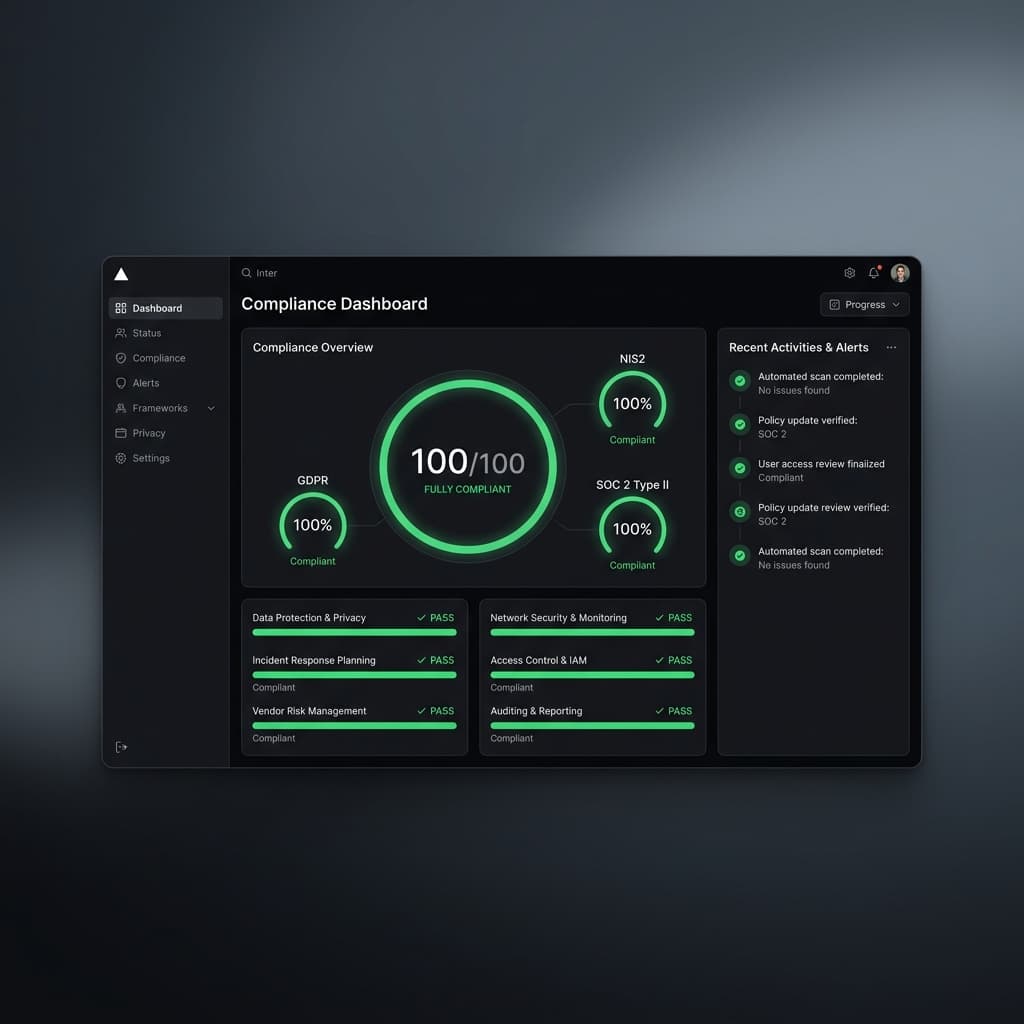
- Real-time Compliance Posture: You get a dashboard mapping your infra to ENISA controls. Real-time exports. No more sweating over audits.
Engineering for Resilience
The 2026 DORA mandate is an engineering problem dressed up in legal text. Map ENISA guidelines to Next.js App Router—use server-only modules, OpenTelemetry, strict CSPs, and SBOMs—and you actually build systems that don't suck. Tools like Bryxe turn compliance from a massive pain in the ass into just another automated step in your pipeline.