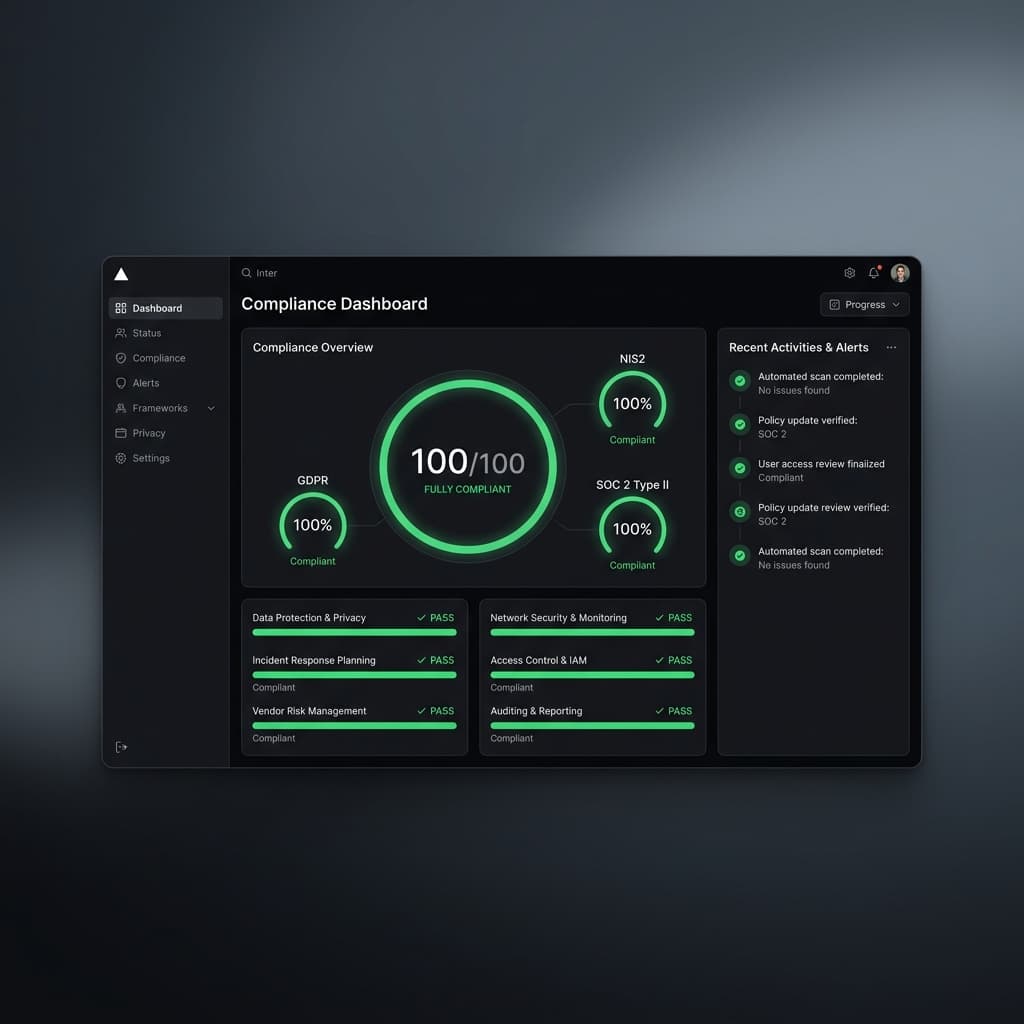
On August 2, 2026, the European Union's regulatory framework for high-risk artificial intelligence systems enters full legal force. Simultaneously, the NIS2 Directive is now active across all 27 EU member states, introducing direct personal liability for corporate executives and technical directors regarding cybersecurity negligence.
If your SaaS company serves customers located within the European Economic Area, compliance is no longer a legal abstraction relegated to annual privacy policy updates. European enterprise procurement teams in Germany, France, and the Nordics are now rejecting software vendors who cannot provide technical proof of compliance with the EU AI Act, NIS2, and GDPR.
Non-compliance carries existential financial penalties: up to €35,000,000 or 7% of global annual turnover for EU AI Act violations, and up to €10,000,000 or 2% of turnover under NIS2.
This technical blueprint translates European regulatory statutes directly into concrete database schemas, cryptographic logging patterns, and infrastructure requirements.
1. Classification: Does the EU AI Act Apply to Your Application?
The regulation establishes a risk-based categorization scheme:
- Prohibited Systems (Article 5): Social scoring systems, cognitive behavioral manipulation, biometric categorization inferred from sensitive traits. Completely illegal.
- High-Risk AI Systems (Annex III): Software utilized in employment screening, CV parsing, educational evaluation, credit scoring, health risk assessment, and critical infrastructure management.
- General Purpose AI (GPAI): Foundation models (Anthropic, OpenAI, Mistral).
- Specific Transparency Risk (Article 50): Interactive conversational agents (chatbots), deepfake/synthetic media generation, and biometric emotion detection.
If your B2B SaaS uses LLMs to score sales leads, rank candidate applications, or automate financial/medical advice, your product is classified as High-Risk.
Even for standard SaaS applications that include an AI assistant or text-generation feature, you are legally bound by Article 50 Transparency Obligations: you must clearly notify users that they are interacting with an AI system and watermarking or labeling machine-generated output.
2. Article-by-Article Code Translation (High-Risk Obligations)
Article 12: Automated Event Logging
High-risk AI systems must implement automated technical logging throughout their lifecycle to guarantee traceability.
You must record: - The exact prompt input and completion response. - Millisecond timestamps synchronized via NTP. - User and tenant identity. - Cryptographic SHA-256 integrity hash ensuring logs cannot be retroactively altered. - Minimum 6-month retention period.
// lib/server/audit-logger.ts
import { prisma } from '@/lib/db';
import crypto from 'node:crypto';

export async function logAIInference(entry: {
  userId: string;
  tenantId: string;
  model: string;
  prompt: string;
  response: string;
  latencyMs: number;
}) {
  const hash = crypto
    .createHash('sha256')
    .update(`${entry.userId}:${entry.prompt}:${entry.response}:${Date.now()}`)
    .digest('hex');

  await prisma.aiAuditLog.create({
    data: {
      userId: entry.userId,
      tenantId: entry.tenantId,
      model: entry.model,
      promptTokens: entry.prompt.length,
      completionTokens: entry.response.length,
      latencyMs: entry.latencyMs,
      integrityHash: hash,
      createdAt: new Date(),
    },
  });
}
Article 14: Human-in-the-Loop Override & Emergency Kill-Switch
The software architecture must empower human operators to oversee the system, detect anomalies, and override or immediately halt autonomous executions.
You must build:
1. An administrative override dashboard allowing human operators to reverse automated classifications.
2. An instant global kill-switch (ai_inference_enabled = false) cached in Redis that halts AI generation within 50ms without crashing the core web application.
// lib/server/ai-guard.ts
import { redis } from '@/lib/redis';

export async function assertAIInferenceAllowed(): Promise<void> {
  const isKilled = await redis.get('KILL_SWITCH_AI_INFERENCE');
  if (isKilled === 'true') {
    throw new Error('503 Service Unavailable: AI inference temporarily suspended by administrator');
  }
}
Article 15: Cybersecurity & Adversarial Robustness
High-risk AI systems must be resilient against third-party exploitation attempts, including: - Prompt Injection & Jailbreaks: Enforcing structural input boundaries. - Model Poisoning: Rigorous cryptographic validation of vector database embeddings. - Data Exfiltration: Outbound content filtering before displaying LLM completions to end-users.
3. NIS2 Directive: Mandatory Security Controls for SaaS Providers
The NIS2 directive establishes strict baseline cybersecurity requirements across the digital supply chain:
1. Mandatory Multi-Factor Authentication (MFA)
Article 21(2)(j) explicitly mandates MFA or continuous authentication solutions across all systems accessing corporate or customer data. If your admin dashboard or customer workspace permits single-factor password logins, you violate NIS2.
2. The 24-Hour Incident Reporting Mandate
When a significant security incident occurs: - Early Warning: Must be submitted to the competent national authority within 24 hours. - Incident Notification: Detailed initial assessment within 72 hours. - Final Report: Comprehensive post-mortem within 1 month.
Your infrastructure must include automated telemetry hooks to notify your internal on-call security response team the moment an abnormal rate of authorization failures or mass data egress is observed.
3. Supply Chain Security (Third-Party Open Source)
Under Article 21(2)(d), organizations are legally accountable for vulnerabilities within third-party packages in their dependency graph. Automated scanning against the OSV.dev and CVE databases is mandatory.
4. GDPR Article 17: The Right to Erasure Pipeline
European regulators frequently test GDPR compliance with one operational inquiry: What happens when a user clicks "Delete Account"?
If your system simply flips an is_deleted = true soft-delete boolean in Postgres, you are in breach of Article 17.
A compliant erasure pipeline must execute cascading hard-deletes: 1. Primary Database: Anonymize or permanently delete user records in Postgres/MySQL. 2. Caches: Evict active JWT tokens and sessions from Redis. 3. Third-Party Processors: Issue API calls to delete customer records in Stripe, PostHog, and Resend. 4. Vector Embeddings: Purge user-specific document embeddings from Pinecone or pgvector.
5. Technical Due Diligence Checklist for Enterprise SaaS
Before selling into the European market, ensure your repository passes these verification checks:
- [ ] Every API endpoint with sensitive data enforces session authentication.
- [ ] Multi-Factor Authentication (TOTP / WebAuthn) is enforced on administrative accounts.
- [ ] Database contains an immutable, timestamped audit log for all AI inference events.
- [ ] Automated account erasure endpoint purges third-party services within 30 days.
- [ ] All npm/PyPI dependencies are continuously scanned for CVEs with zero critical vulnerabilities.
- [ ] An emergency kill-switch is deployed to disable AI models during operational anomalies.
Automate Your EU Compliance Audit with Bryxe Shield
Manually cross-referencing 64 individual statutory articles across GDPR, NIS2, EU AI Act, and DORA requires weeks of specialized security consulting.
Bryxe Shield automates this verification in 60 seconds: - Automatically scans your codebase against regulatory articles. - Evaluates encryption, MFA, data sanitization, and logging mechanisms. - Generates an audit-ready, downloadable PDF compliance report.
Start your compliance readiness assessment today at bryxe.app/eu-compliance.